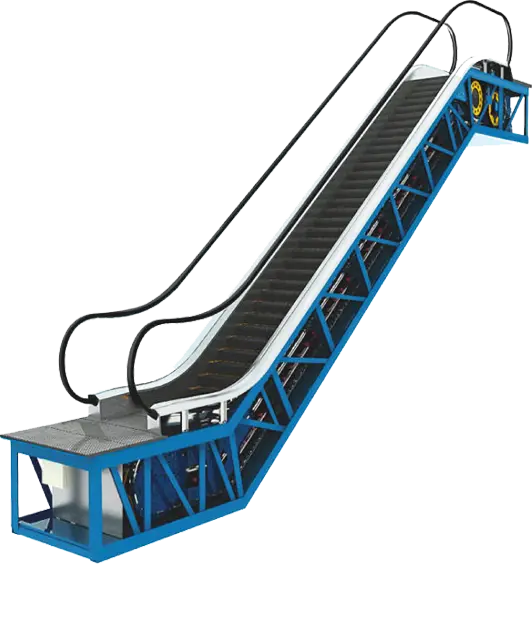
Energy-Efficient Escalators for High Rise Buildings
Escalators – Advanced Vertical Transportation for Modern Infrastructure
In today's fast-paced urban environments, the escalator stands as an essential component of vertical transportation, seamlessly enabling the movement of people across floors in high rise buildings, commercial buildings, airports, shopping malls, metro stations, and residential complexes.
Combining safety, efficiency, and durability, our escalators are built using premium-grade elevator components and engineered to meet the evolving needs of public and private infrastructure. Designed to transport people quickly, these systems feature advanced control technology, aesthetic handrail designs, and reliable braking mechanisms to ensure a safe and comfortable ride.
✅ Key Features & Benefits:
1. Seamless Vertical Transportation
Escalators provide continuous and efficient movement of people between levels without waiting times, unlike elevators. This makes them ideal for locations with high foot traffic, such as shopping centers, airports, metro stations, and commercial buildings.
2. Reliable Elevator Components
Every unit is built with robust elevator components such as motors, chains, balustrades, and handrail systems. These parts ensure longevity, low maintenance, and consistent operation, even during peak hours.
3. Energy Consumption Efficiency
Modern escalators are designed to optimize energy consumption. Features like variable frequency drives (VFDs) and automatic start-stop mechanisms reduce electricity use when passenger flow is low, enhancing sustainability.
4. Heavy-Duty Weight Capacity
With a weight capacity tailored to the demands of public spaces, escalators can support continuous usage by hundreds of people per hour. They are available in multiple incline angles and step widths to suit various building codes and space requirements.
5. Enhanced Aesthetics for Modern Buildings
Our escalators offer sleek, modern designs that match the aesthetics of any residential building, high-rise tower, or commercial complex. Customizable finishes, LED step lighting, and glass balustrades make them a visual highlight.
6. Safety & Compliance
All escalators meet international safety standards (EN 115, ASME A17.1) and include features such as:
-
Step demarcation lighting
-
Emergency stop buttons
-
Handrail speed monitoring
-
Skirt panel deflectors
-
Anti-slip steps and comb plates
7. Custom Applications Across Industries
Our escalators serve a wide range of applications including:
-
Airports and transport terminals
-
Shopping malls and entertainment centers
-
Corporate offices and skyscrapers
-
Hospitals and healthcare complexes
-
Residential buildings and condominiums
Whether you require an indoor, outdoor, or inclined travelator, we offer customized escalator models based on specific vertical transportation needs.
✅ Technical Specifications Overview:
| Parameter |
Details |
| Inclination |
30° or 35° |
| Step Width |
600mm / 800mm / 1000mm |
| Speed |
0.5 m/s (standard) |
| Drive Mode |
VVVF (Variable Voltage Variable Frequency) |
| Weight Capacity |
Up to 9000 persons/hour |
| Operation Mode |
Continuous / Automatic Start-Stop |
| Energy Saving |
Yes, with VFD |
| Compliance |
CE / ISO / EN 115 Certified |
🔧 Installation & Maintenance
We provide full turnkey solutions from design consultation to installation and post-installation maintenance. Our experienced technicians ensure that each escalator is optimized for safe, smooth operation and long-term reliability.
🏙️ Why Choose Our Escalators?
-
Designed for vertical transportation in high-density zones
-
Easy integration into residential and commercial buildings
-
Energy-efficient operation reducing running costs
-
Excellent durability with minimal maintenance
-
Flexible design to suit any architectural style
❓Q/A – Elevator & Escalator Industry FAQs
Q1: What’s the difference between an escalator and an elevator?
A: An escalator continuously transports people between floors without waiting, while an elevator transports people in a cabin (elevator car) and stops at set levels.
Q2: How much energy does an escalator consume?
A: Energy consumption varies based on traffic. Modern escalators with VVVF drives can save up to 30% energy during low-use periods by slowing or stopping automatically.
Q3: Are escalators suitable for residential buildings?
A: Yes, especially in multi-story apartments, condominiums, or shared facilities where fast, ramp-free vertical transportation is required.
Q4: What is the weight capacity of an escalator?
A: Escalators are typically rated by flow capacity (e.g., 6000–9000 people/hour). The steps and mechanical structure are engineered to handle this safely.
Q5: How often do escalators need maintenance?
A: Routine maintenance is typically required every 1–3 months, depending on usage volume and installation environment. Regular servicing ensures long-term reliability.